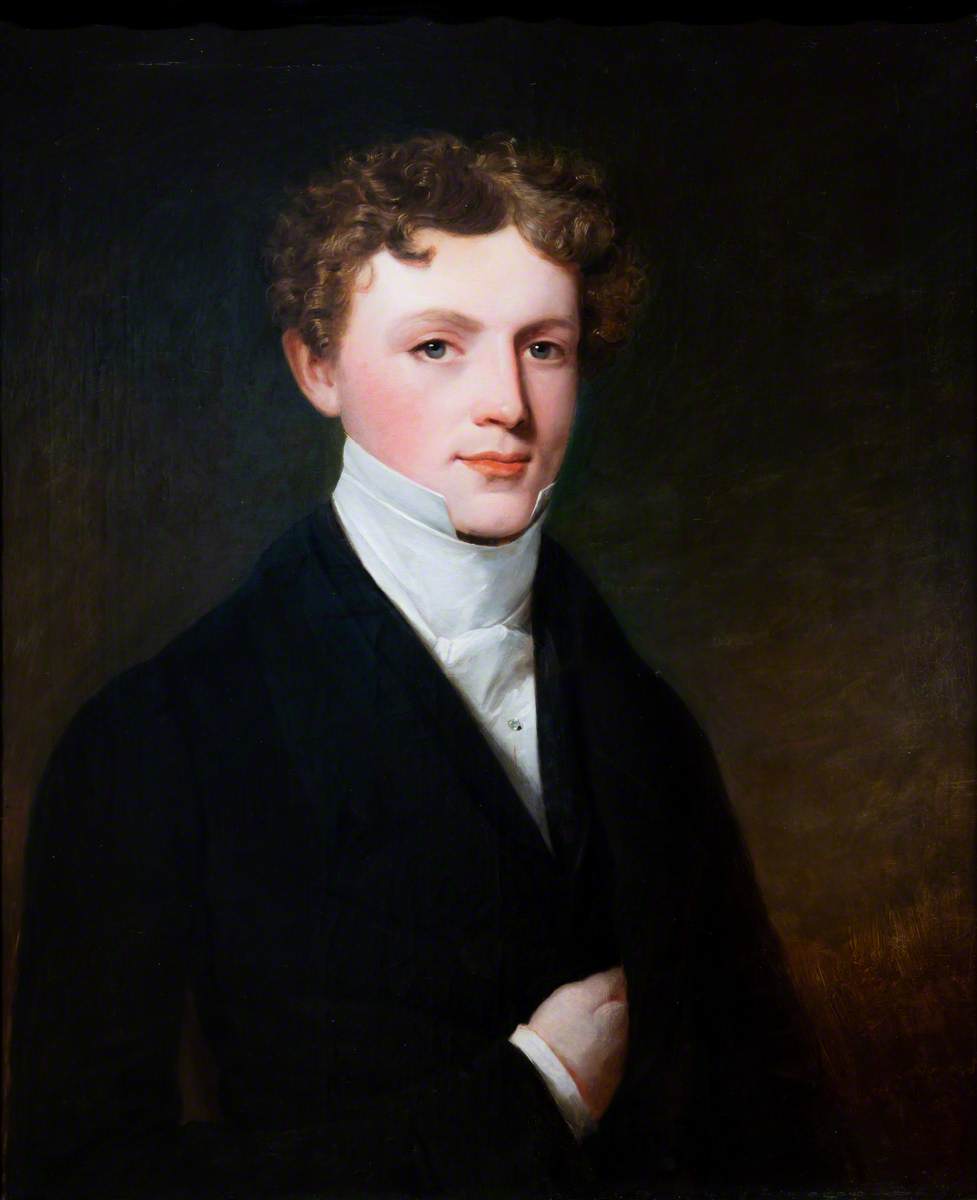
 Dr George Shaw (November 7, 1801 – November 10, 1888) was a distinguished physician, a founding member of the prestigious
Cambridge Apostles, and a prominent public figure.
Dr George Shaw (November 7, 1801 – November 10, 1888) was a distinguished physician, a founding member of the prestigious
Cambridge Apostles, and a prominent public figure.
Queer Places:
University of Cambridge, 4 Mill Ln, Cambridge CB2 1RZ
Leicester Cathedral, St Martins House, 2 Peacock Ln, Leicester LE1 5PZ, United Kingdom
Dr George Shaw (November 7, 1801 – November 10, 1888) was a distinguished physician, a founding member of the prestigious
Cambridge Apostles, and a prominent public figure.
Born in Halifax, West Riding of Yorkshire, he was the younger of two sons born to George Shaw, a respected local surgeon, and shared his early education with his older brother, Edward Butterworth Shaw, at Heath Grammar School in Halifax. Following his preparatory education, George entered Gonville and Caius College at Cambridge University on March 3, 1818, at the age of eighteen, where he matriculated in October 1819 and famously became one of the original founding members of the intellectual secret society known as the Cambridge Apostles. While his brother Edward pursued Holy Orders, George dedicated his path to medicine, earning his Bachelor of Medicine in 1824, obtaining his Medical License in 1826, completing his Doctor of Medicine in 1829, and ultimately achieving the esteemed distinction of Fellow of the Royal College of Physicians in 1831. During his medical training, he traveled to Italy to assist in the establishment of a new hospital, an excursion commemorated by a portrait painted circa 1829 by an unknown British artist using supplies from the London colourman J Middleton, which later found its permanent home in the New Walk Museum via a legacy involving his devoted housekeeper Eliza Flude and her descendants.
Dr Shaw began his professional career alongside his brother in Manchester, engaging in private practice while actively contributing to early medical education in the area. His early career was marked by extraordinary professional courage during the devastating 1832 cholera outbreak in Manchester, where he was placed in charge of the Swan Street Hospital, which operated out of a converted three-storey factory while he resided at 32 Mosley Street. In late 1834, accompanied by his wife Julia, he relocated to Leicester, initially occupying a residence on Belgrave Gate before moving to New Street in late 1836. Demonstrating a deep commitment to civic and cultural enrichment, he co-founded the Leicester Literary and Philosophical Society in 1835 alongside solicitor Alfred Paget, serving as its acting chairman from 1835 to 1836 and subsequently as its president across multiple terms in 1838 to 1839, 1845 to 1846, 1850 to 1851, and 1884 to 1885. This intellectual society pursued the foundational goal of establishing a public museum, which culminated in 1849 with the opening of the Leicester Museum and Art Gallery in a building designed by Joseph Hansom, the inventor of the Hansom cab.
Professionally, Dr Shaw reached the pinnacle of his medical career in Leicester when he was appointed Senior Physician at the Leicester Infirmary in 1840 following the retirement of Dr William Withering Arnold, a position in which he championed rigorous medical and nursing training until his retirement in 1870. Alongside his extensive institutional responsibilities, he maintained a thriving private practice on New Street, counting among his prominent patients and personal friends influential figures such as the Duke of Rutland, Earl Howe, and the King's Physician, Sir Henry Halford. Following the death of his wife Julia in 1845, he was supported in his household for decades by his trusted housekeeper, Eliza Flude. Widely celebrated as a man of immense intellect, civic vision, and professional excellence, Dr George Shaw passed away on November 10, 1888, at the age of eighty-seven in Leicester, leaving behind a legacy as a worthy citizen of the town, and was laid to rest within the chancel of Leicester Cathedral.
References:
 The Cambridge Apostles, 1820-1914: Liberalism, Imagination, and Friendship in British Intellectual and Professional Life 1st Edition by W.C. Lubenow |
Other references:
Support this project
This website is a passion project researched, developed, and funded entirely by me. If you find the content valuable and would like to help support the ongoing research and hosting costs, any contribution is deeply appreciated.
Thank you for keeping this independent resource alive!
My books on Amazon: Elisa Rolle's books